The Courier Press of Prairie du Chien, WI, recently advised that an eight-foot painting of the Anunciation, referred to in another post on this page, once again hangs above the altar of the church. The painting was taken down decades ago and sold at an auction held by St. Gabriel's. Here's the article about the event by Don Eastman. Unfortunately it bears no date:
http://prairiecatholic.org/History/StGabrielAuction197_.pdf
The Anunciation was purchased by Mary Barrette, a descendant of one of the oldest families of the town. Not long ago the painting was returned to St. Gabriel's and then underwent restoration.

Monday, August 6, 2012


Sunday, June 10, 2012
French-Indian Ancestry Research
Here's a website with a resident expert to assist with genealogical research--free!
http://www.frenchindancestry.proboards.com/
http://www.frenchindancestry.proboards.com/
Monday, May 7, 2012
Who Beat Up the Intruder?
Speaking of Father Galtier--this is definitely on the lighter side. Small-town newspapers of the 19th Century tended to print some items in a rather quaint fashion. The Prairie du Chien Patriot was no exception. It put out an issue on Thursday, July 30, 1857 containing a tongue-in-cheek report that went like this:
"A chap who looked as if he had been on a swell and had the blues to pay for it was up before justice Wright on Saturday last charged with attempting to break into the dwelling house of the Rev. Mr. Galtier. He didn't get into the house but got an awful pummelling. The poor fellow was too drunk to distinguish a dwelling house from a brick yard.--He was discharged."
This brief article could have been worded a bit better, as it lends the distinct impression that the drunk got beat up by a priest! Well, perhaps he did. However, from what I know about Father Lucien Galtier, I doubt he did the "pummelling". One can't envision him applying a beating to an intoxicated man--except possibly in self-defense. One can't know exactly what happened in the circumstances, but the would-be intruder ran afoul of someone, apparently. Was it Fr. Galtier or an outraged neighbor or passer-by? I suppose anything is possible in a frontier town, where even the local druggist sold "guns and pistols".
Thursday, April 26, 2012
The Lost Diary of Father Lucien Galtier
A researcher and avid historian named Peter Scanlan wrote to Fr. William Busch of St. Paul, MN, about an item of interest to both men. Scanlan, a medical doctor, lived in Prairie du Chien and sent his letter in 1906 during the pastorate of Father Alphonse Joerres [1899-1907] of St. Gabriel Archangel Catholic Church of that town, as that priest is mentioned in the missive. The letter or a copy thereof is contained in the Minnesota Historical Society archives.
Scanlan rendered a description to Fr. Busch of a bound journal of about 340 pages, the diary of the late Father Lucien Galtier, depicted above. Galtier had died at his post at St. Gabriel's in 1866. From his description, brief as it is, this journal appears to have been very interesting, although it was not the sort of daybook in which one entered ones personal thoughts and experiences. Mostly it consisted of record-keeping, accounts. When Dr. Scanlan wrote his article, "Pioneer Priests at Prairie du Chien" for the Wisconsin Magazine of History in 1929, he indicated therein that the diary had become lost by then. How could such a thing occur? In his letter to Busch, Scanlan said, "It was the priest's private book but as he died leaving no disposition of it, the parish here would not be willing to give it up."
Scanlan rendered a description to Fr. Busch of a bound journal of about 340 pages, the diary of the late Father Lucien Galtier, depicted above. Galtier had died at his post at St. Gabriel's in 1866. From his description, brief as it is, this journal appears to have been very interesting, although it was not the sort of daybook in which one entered ones personal thoughts and experiences. Mostly it consisted of record-keeping, accounts. When Dr. Scanlan wrote his article, "Pioneer Priests at Prairie du Chien" for the Wisconsin Magazine of History in 1929, he indicated therein that the diary had become lost by then. How could such a thing occur? In his letter to Busch, Scanlan said, "It was the priest's private book but as he died leaving no disposition of it, the parish here would not be willing to give it up."
Lucien Galtier was, after all, a man of some renown. He had been the first Catholic priest to be sent in 1840 to what is now the large city of St. Paul, built the first church there, and was credited with giving the city its name. This is indicated on the tomb of the priest, located in front of St. Gabriel's, By the beginning of the 20th Century, Galtier's diary would have been coveted by the Archdiocese of St. Paul [which claims not to have it] as a major heirloom, the historical societies of Minnesota and Wisconsin for its content [they don't possess it, either]--not to mention private collectors for their own reasons. St. Peter's church of Mendota, Minnesota [a stone ediface that succeeded the earlier one of timber that Galtier built there] treasures a wooden altar that is very likely to have been constructed by the priest with his own hands.


Was the journal really lost--or is it just a case of "misplaced"? In 1956 Father Earl L. Burns, then the pastor of St. Gabriel's, printed a booklet regarding a drive to raise the $250,000 needed for a new school. In it Burns remarked that Father Galtier wrote in his diary that the church, itself, took 18 years to complete. How did Father Burns, who didn't come to St. Gabe's until 1954, know what was contained in Galtier's diary? Peter Scanlan didn't die until 1956, so Burns may have learned some things about the journal from the historian or from someone else of the parish who had studied it more than 25 years earlier. Notice I write "studied" instead of merely "read". As Galtier's biographer I know only too well how difficult his handwriting is to decipher. It took getting used to. No one but those accustomed to the French penmanship of the 19th Century would find it easy. Scanlan, too, evidently had trouble in interpreting what was there judging by something he wrote in his description. It's very possible Father Burns received his information second hand, but it's also possible he had seen the diary with his own eyes. It seems odd that the pastor would even mention the journal if it had been lost, as its disappearance would have been an embarrassment to the church in 1956. In this same fund-raising publication something was mentioned about the place "where Father Galtier kept his horse". How was this recalled a century later? The rumor is that Burns had risked the church funds on the stock market but had triumphed and the school was built. Changes were also made to the interior of the church that were not so well-received by the congregation. Father Burns, it is recalled, was a very determined person and did things on his own initiative. At any rate, he was in a perfect position to have access to Galtier's journal, if it still existed at Prairie du Chien.
Outside of his marble tomb in front of St. Gabriel's, it is difficult to find a trace of Father Galtier in Prairie du Chien now. Rumors abound, however. The priests of the Diocese of La Crosse, who serve the parish, have let it be known that Galtier is not even buried beneath his white monument any longer--but this writer could not find any documentation anywhere that his remains had been moved--nor was such a process known to a current historian of Prairie du Chien. Old people of the city had been interviewed by the same scholar and nobody had heard of the move. However, some years ago the tomb had been surrounded by concrete [it was in a photo from 1925, for example] which was taken away in favor of grass at some point [after 1971, the date of the most recent photo I could find with the concrete still evident]. Is it possible Galtier's grave was entered then? If so, where are his bones? Regardless, they were presumed to be still in their original grave in June of 1941 when a delegation from St. Paul made a pilgrimage to St. Gabriel's in honor of the pioneer priest. In this photo of the '41 ceremony, there is a large slab of stone under the tomb that no longer appears to be there today, nor was it there in the 1971 photograph.


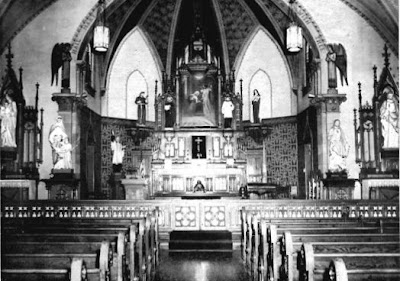
The time came when it was decided that the interior of St. Gabriel's should be completely redone in a far simpler style. To this end the church held a giant auction during the 1970's in which the paintings, statues, pews, candle sticks, etc. of the decor that had more or less prevailed for over a century fell under the auctioneer's gavel. Even an eight-foot painting of the Anunciation that had long hung over the altar was sold to a private party, who, when asked, was not quite sure what she would do with it at the time. A portrait of Lucien Galtier had hung in the old parish school, but when I inquired what had become of that, a school authority could not provide the answer. It had apparently not been transferred to the present school. Galtier's brick house, which he had willed to the congregation to be used as a Catholic school, has been torn down. I have been informed that the priest's vestments, which were very beautiful and of considerable historic value, had "been donated to the missions", meaning foreign ones most likely. Below is the way the inside of St. Gabriel's appeared prior to the major change:
Fast forward to 1986, the year St. Gabriel's celebrated it sesquicentennial of existence by issing a calendar that related the long history of the parish. There is a picture of Father Galtier and his tomb and the words "He was an artist, a singer, and played violin. He was a businessman and acted as banker for some of his parishioners." As there can't have been anyone alive in 1986 who had known Lucien Galtier, the information about his talents and activities had to be obtained from a written source. It is true that his colleague in Minnesota, Fr. Augustin Ravoux, had mentioned in a published memoir that Galtier possessed a splendid singing voice, but he had said nothing about the violin or art. Nor had Dr. Scanlan in his letter to Fr. Busch. Although Scanlan wrote that the diary reflected Galtier's business activities, among other things, the doctor misunderstood that the priest was an agent for a bank. The will of Father Galtier [not lost and published in my biography of the priest] does mention sums he was holding for certain parishioneers. But how was it known in 1986 that Lucien had been an artist and played an instrument? What survived to attest to these abilities?

Fast forward to 1986, the year St. Gabriel's celebrated it sesquicentennial of existence by issing a calendar that related the long history of the parish. There is a picture of Father Galtier and his tomb and the words "He was an artist, a singer, and played violin. He was a businessman and acted as banker for some of his parishioners." As there can't have been anyone alive in 1986 who had known Lucien Galtier, the information about his talents and activities had to be obtained from a written source. It is true that his colleague in Minnesota, Fr. Augustin Ravoux, had mentioned in a published memoir that Galtier possessed a splendid singing voice, but he had said nothing about the violin or art. Nor had Dr. Scanlan in his letter to Fr. Busch. Although Scanlan wrote that the diary reflected Galtier's business activities, among other things, the doctor misunderstood that the priest was an agent for a bank. The will of Father Galtier [not lost and published in my biography of the priest] does mention sums he was holding for certain parishioneers. But how was it known in 1986 that Lucien had been an artist and played an instrument? What survived to attest to these abilities?
In 1866, the year of his death, the priest's housekeeper was Mary Garvey, to whom he bequeathed most of his household furnishings and what became of these later is unknown. However, many other things, including paintings and a silver watch were delivered to Galtier's friend and former live-in housekeeper, Penelope McLeod of the town, according to an inventory of the probate court by direction of Galtier [although Miss McLeod is not mentioned in his testament] and their fate is also a mystery to the present writer. A couple of the paintings with religious subjects were meant for the church and may have eventually found their way into the auction. Some items were intended for Galtier's nephew, a priest in France, but I have no idea if he ever came to claim them.
Friday, March 30, 2012
Beautiful 1816 Document from Prairie du Chien
 |
| By permission of the Wisconsin Historical Society |
The above document was composed at Prairie du Chien in 1816 and was donated to the Wisconsin Historical Society in 2010 by the descendants of one of the petitioners to Congress named in writing. It is supposed to be in the hand of John W. Johnson, fur trader, one of the few persons at Prairie du Chien who could write well in the English language in that year. The rest were French speakers. 54 individuals, mostly making their marks, asked Congress to award them legal title to their lands and homes, as their fathers or grandfathers had been settlers since 1755. In addition to its historic significance, the document should be helpful to genealogists, as it attests to certain parties being residents as early as 1816, at least. The rest of the pages of the petition, in remarkably fine condition for its age, a transcription and more information in the form of a description can be seen on the society's website at
http://content.wisconsinhistory.org/cdm4/document.php?CISOROOT=/tp&CISOPTR=72462&CISOSHOW=72455
I
Saturday, March 17, 2012
Alexander Robinson and the Occult
Alexander Robinson was the Anglo name of Chee-chee-pin-quay, chief of the Pottawatomi, Chippewa and Ottawa Nation of Indians. He was instrumental in negotiating the 1812 Treaty of St. Louis and the 1829 Treaty of Prairie du Chien. One can read more about Robinson here:
For services to the US government, Alexander, the son of a white man and a Native American woman, was given a large tract of land in Illinois, now called Robinson Woods, which in more modern times has been associated with some strange doings, including paranormal activity:
Here's a photograph of Alexander Robinson, whose Indian names means "the Squinter": |
Saturday, March 10, 2012
Curing the Ague
 During the 19th Century, the ague meant a fever, usually recurring, accompanied by chills. Mainly it signified malaria and sometimes conditions difficult to diagnose in those days. Dr. C. V. Porter, physician and historian living at Viroqua in Wisconsin, wrote these interesting observations sometime in the earlier part of the 20th Century when, apparently, such fevers were no longer common along the great river.
"Little does this generation know of the terrible chills and high fever, 105. or 6 degrees and the profuse sweating that made up a single day of the ague. 'Nothing but the ague' and to have it for months was terrible, and what fools we were not to adopt the cold water treatment. Emmet Sterling, raftsman on the river, contracted ague. He got dope from half the towns on the Mississippi and still he shook. In desperation, at the height of his fever, when the skin was hot and dry, he got in between two logs of his raft and hung in the water. an hour or more and his ague left him forever.
I was called one October night 40 years ago to Johnstown to see a worthless fellow delerious from malarial fever. When I got there I found that Uncle Henry Lester had brought from the spring a pail of cold water, wrung out a sheet and wrapped the fellow up in it and had kept the sheet wet for an hour or more. I found his [the patient] temperature normal and he was asleep. He had no more fever for a week and then had dumb ague [lacking the characteristic chills]. To prevent this later, I took 2 grains of strychnine, two grains of arsenic, 40 grains of quinine and 30 grains of sulphate of iron, mixed them and made the mass into 80 pills and gave two pills after each meal. I had ten cases of remittent fever that fall on the ridges [river bluffs?] and promptly cured them that way. I gave the pills, six each day, on the 5th. 6th and 7th days after the last chill; on the 11th, 12th, 13th, 19th, 20th, 21st, 26th and 27th days and the malaria was done for."
The Courier of Prairie du Chien ran an ad in 1857 that exhorted:
Cure the Fever & Ague
Use Brower & Van Duzer's
Ague Mixture, 50 cents
One wonders what that potion contained.
The Courier of Prairie du Chien ran an ad in 1857 that exhorted:
Cure the Fever & Ague
Use Brower & Van Duzer's
Ague Mixture, 50 cents
One wonders what that potion contained.
Subscribe to:
Posts (Atom)